
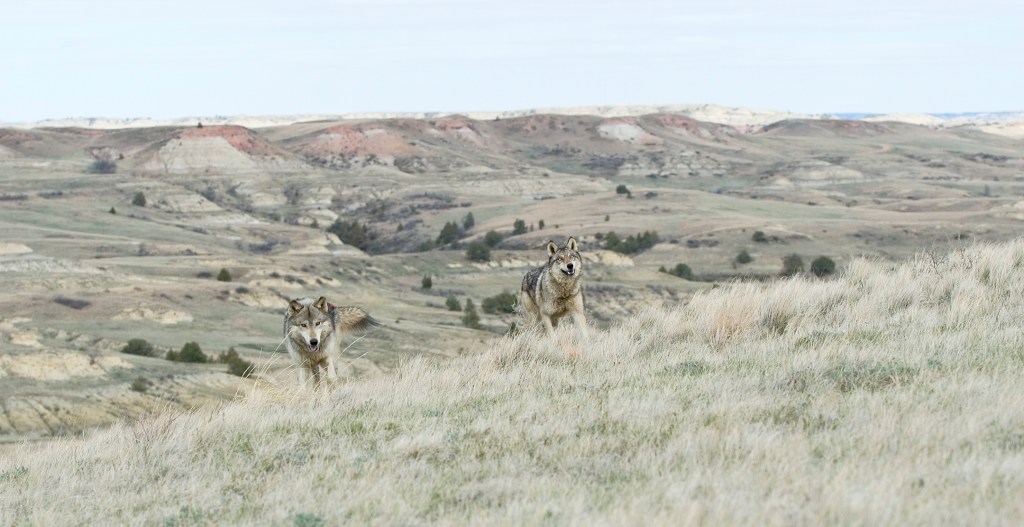
Gray Wolf Ecology
One of the most iconic comeback stories in modern carnivore conservation, gray wolves are naturally recolonizing portions of their former range in California.
Returning to former range
The gray wolf (Canis lupus) is currently classified as Least Concern on the IUCN Red List because of its broad global distribution and overall population stability (IUCN SSC Canid Specialist Group 2016). Historically widespread across the Northern Hemisphere, wolves were extirpated from much of the contiguous United States by the early twentieth century.
Today, wolves are naturally recolonizing portions of their former range. In California, gray wolves are listed as endangered under the California Endangered Species Act and are managed under a phased conservation framework as the population reestablishes (Kovacs et al. 2016).
Biology and behavior
Gray wolves are the largest canids in North America. Their body size varies by region, sex, and prey availability, while their social lives center on closely connected family groups.
Built for endurance
Adult males typically weigh 80–110 pounds and females 60–90 pounds. Adults measure approximately 4.5–6.5 feet from nose to tail and stand about 26–32 inches at the shoulder (Mech and Boitani 2003).
Pack social structure
A wolf pack is generally a family group centered on a breeding pair and their offspring. Pack members cooperate in raising pups, defending territory, and locating and capturing prey.
Long-distance travelers
Young wolves commonly leave their natal pack between one and three years of age. Dispersers may travel long distances while seeking unrelated mates and unoccupied territory.
Raising the next generation
Gray wolves typically reach sexual maturity at approximately two to three years of age, although not all mature wolves breed immediately. In most packs, reproduction is limited to the breeding pair.
Throughout summer, pups remain at den or rendezvous sites while pack members bring food and provide protection. By autumn, young wolves begin traveling with the pack and gradually participate in hunts. Juveniles may remain with their natal pack for one or two years before dispersing to seek mates and establish new territories (Mech and Boitani 2003; Morgan 2011; Oregon Department of Fish and Wildlife 2017).
Hunting and diet
Primarily wild ungulates
Gray wolves are obligate carnivores whose diet consists primarily of large ungulates, including deer and elk throughout much of the western United States (Mech and Boitani 2003; Kovacs et al. 2016). Livestock typically becomes a larger dietary component only when wild prey is limited (Janeiro-Otero et al. 2020).
Endurance and cooperation
Wolves are cursorial predators that rely on endurance and coordinated pack behavior rather than ambush. Effective hunting requires sufficient prey density and connected landscapes that allow wolves to travel, patrol their territories, and track migrating ungulates.
Packs may move seasonally to areas where hunting success is greater. Prey distribution shifts with weather and forage availability, so larger, connected territories help packs maintain access to prey throughout the year (Mech and Boitani 2003).
Territorial dynamics
Gray wolf packs occupy defined territories that are actively maintained and defended. Territory size varies with prey density and habitat productivity and may range from several hundred to more than one thousand square miles (Mech and Boitani 2003; Fuller et al. 2003; Kovacs et al. 2016).
Neighboring packs typically avoid one another by using scent marking and howling to signal occupancy. Conflict between packs is a natural part of wolf population dynamics and can result in injury or mortality. Territorial structure helps regulate wolf density and competition across landscapes (Peterson and Ciucci 2003; Fuller et al. 2003).
The structure and stability of pack territories are closely tied to environmental conditions, prey availability, and wolf population density.
Livestock and coexistence
Wolves generally prefer wild ungulates when natural prey is sufficiently available. Where livestock density is high and prey availability is limited, the potential for conflict increases (Janeiro-Otero et al. 2020; Anderson et al. 2024; Kovacs et al. 2016).
Fladry
Lines of red flags hung along fencing can temporarily deter wolves. Because habituation may occur after roughly 60 days, fladry is often most useful during focused seasonal periods such as calving or lambing (Musiani et al. 2003).
Livestock timing and placement
Concentrating births within shorter windows and moving animals into smaller, more defensible pastures near human activity can reduce vulnerability during critical periods.
Range riders
Consistent human presence with herds is associated with reduced depredation risk and can help producers detect wolf activity and respond earlier (Anderson et al. 2024; Bogezi et al. 2021).
Technology-assisted deterrence
Tools such as radio-activated guard boxes use collar signals to trigger aversive stimuli when wolves approach livestock (Primi et al. 2024).
In 2025, the Beyem Seyo pack in Northern California was associated with unprecedented livestock losses. Agencies and producers used extensive non-lethal deterrence before adult wolves were ultimately removed after other measures proved unsuccessful. Economic analyses estimated that livestock losses and deterrence costs reached into the millions of dollars over a single season, with more than one million dollars spent on hazing efforts alone (Agri-Pulse West 2025; Associated Press 2025).
Because wolves recolonized California naturally rather than being introduced as an experimental population, they remain protected under state and federal law. Management responses to depredation occur within a regulated framework (Kovacs et al. 2016), which can contribute to tension among ranchers, wildlife advocates, and agencies. Although statewide economic effects may be limited, losses can be severe for individual producers. Lethal control also does not always reduce long-term depredation and may destabilize pack structure (Muhly and Musiani 2009; Santiago-Avila et al. 2018).
Ultimately, coexistence is both an ecological and a social issue. Ranchers and livestock producers work within economic, environmental, and regulatory pressures that are often invisible to the broader public. Ranching supports food production, families, and rural communities. Research shows that trust, collaboration, and respect are central to effective coexistence strategies (Bogezi et al. 2021). Approaching conflict with empathy and cooperation can produce more durable solutions than assigning blame.
References
View the complete reference list
Agri-Pulse West. 2025. UC analysis details economic impact of Beyem Seyo wolf pack on Northern California cattle operations. Agri-Pulse West. Sacramento, California, USA.
Anderson, R. M., S. Charnley, J. V. Martin, and K. Epstein. 2024. Large, rugged and remote: The challenge of wolf–livestock coexistence on federal lands in the American West. People and Nature 00:1–13.
Associated Press. 2025. California officials remove wolves after repeated livestock depredations despite extensive non-lethal efforts. Associated Press News. New York, New York, USA.
Bogezi, C., L. M. Van Eeden, A. J. Wirsing, and J. M. Marzluff. 2021. Ranchers’ perspectives on participating in non-lethal wolf-livestock coexistence strategies. Frontiers in Conservation Science 2:683732.
Fuller, T. K., L. D. Mech, and J. F. Cochrane. 2003. Wolf population dynamics. Pages 161–191 in L. D. Mech and L. Boitani, editors. Wolves: Behavior, Ecology, and Conservation. University of Chicago Press, Chicago, Illinois, USA.
IUCN SSC Canid Specialist Group. 2016. Canis lupus. The IUCN Red List of Threatened Species 2016. International Union for Conservation of Nature, Cambridge, United Kingdom.
Janeiro-Otero, A., T. M. Newsome, L. M. Van Eeden, W. J. Ripple, and C. F. Dormann. 2020. Grey wolf (Canis lupus) predation on livestock in relation to prey availability. Biological Conservation 243:108433.
Kovacs, K. E., K. E. Converse, M. C. Stopher, J. H. Hobbs, M. L. Sommer, P. J. Figura, D. A. Applebee, D. L. Clifford, and D. J. Michaels. 2016. Conservation Plan for Gray Wolves in California. California Department of Fish and Wildlife, Sacramento, California, USA.
Mech, L. D., and L. Boitani, editors. 2003. Wolves: Behavior, Ecology, and Conservation. University of Chicago Press, Chicago, Illinois, USA.
Morgan, R. 2011. Oregon Wolf Conservation and Management Plan 2011 Annual Report. Oregon Department of Fish and Wildlife, La Grande, Oregon, USA.
Muhly, T. B., and M. Musiani. 2009. Livestock depredation by wolves and the ranching economy in the Northwestern U.S. Ecological Economics 68:2439–2450.
Musiani, M., C. Mamo, L. Boitani, C. Callaghan, C. Gates, L. Mattei, E. Visalberghi, S. Breck, and G. Volpi. 2003. Wolf depredation trends and the use of fladry barriers to protect livestock in western North America. Conservation Biology 17:1538–1547.
Oregon Department of Fish and Wildlife. 2017. Oregon Wolf Conservation and Management Plan (draft). Oregon Department of Fish and Wildlife, Salem, Oregon, USA.
Peterson, R. O., and P. Ciucci. 2003. The wolf as a carnivore. Pages 104–130 in L. D. Mech and L. Boitani, editors. Wolves: Behavior, Ecology, and Conservation. University of Chicago Press, Chicago, Illinois, USA.
Primi, R., P. Viola, P. Girotti, P. P. Danieli, B. Ronchi, and R. Spina. 2024. Performance evaluation of a prototype for the defense against wolf attacks on livestock animals. Acta IMEKO 13:1–7.
Santiago-Avila, F. J., A. M. Cornman, and A. Treves. 2018. Killing wolves to prevent predation on livestock may protect one farm but harm neighbors. PLOS ONE 13:e0189729.