
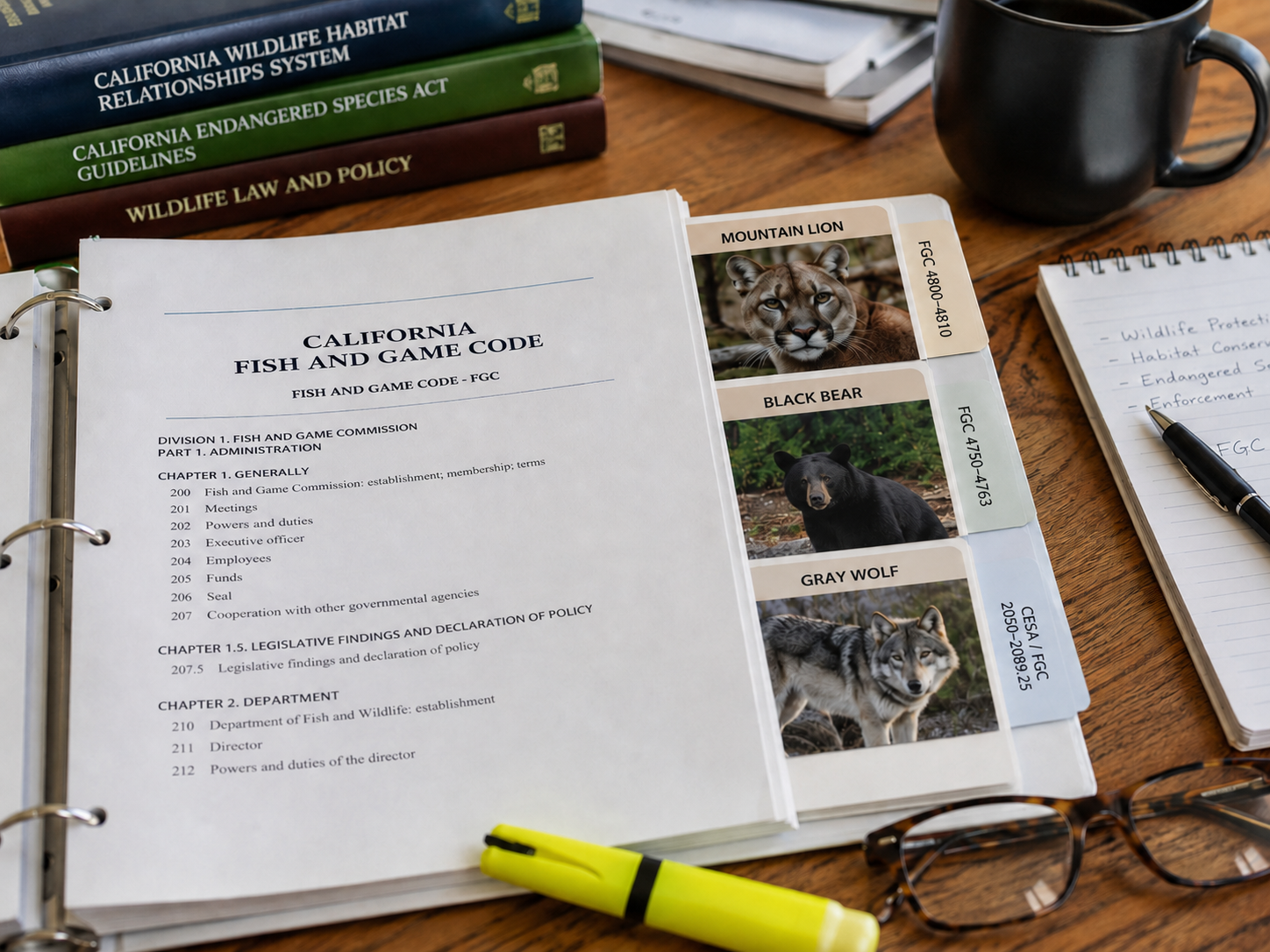
California Fish & Game Code: Mountain Lions
A plain-language guide to Fish and Game Code Sections 4800–4810, including protected status, public safety, depredation permits, immediate take, reporting, and research.
This page is an informational summary, not legal advice. Statutes, regulations, agency policies, and case-specific decisions may change. Always rely on the official California Legislature text and direct guidance from CDFW or a licensed attorney.
What this chapter covers
California’s Fish and Game Code provides the statutory framework for wildlife management and conservation. Chapter 10 of Division 4, Part 3 specifically addresses mountain lions. It was repealed and added by Proposition 117 in 1990 and identifies the mountain lion as a specially protected mammal while establishing limited exceptions involving public safety, livestock or property depredation, authorized possession, and scientific research.
Each section below separates Carnivore Project’s summary from the controlling legal text. Use the official state link provided with every entry before making a legal or safety decision.
Call 911
If a person is in immediate danger, has been attacked, or the animal presents an active public-safety emergency, contact emergency services first.
Call 911Contact CDFW promptly
Preserve the scene, avoid moving the carcass unless necessary, photograph evidence, and use our county directory to find the appropriate wildlife contacts.
Find County ContactsReport the observation
Community reports help document mountain lion activity. A Carnivore Project sighting report does not replace an official CDFW incident or depredation report.
Report a SightingSections 4800 through 4810
Select a section to read what it covers, practical context, and a direct link to the official California Legislature page.
FGC § 4800 Specially protected status, prohibited conduct, and penalties
Mountain lions are specially protected mammals in California. Unless a specific statutory exception applies, taking, injuring, possessing, transporting, importing, or selling a mountain lion or mountain lion product is unlawful.
The section contains limited possession exceptions, including qualifying pre-June 6, 1990 possession and certain authorized scientific or educational uses. A violation may be punished as a misdemeanor by up to one year in county jail, a fine up to $10,000, or both. The section also recognizes self-defense and defense of others.
Specially protected status means there is no general public hunting season for mountain lions in California. It does not eliminate the narrow public-safety, depredation, possession, or research provisions found elsewhere in the chapter.
Read Official Section 4800FGC §§ 4801 & 4801.5 Public safety, threatened sheep, and nonlethal procedures
Section 4801 allows CDFW, or an appropriate local public-safety agency authorized by CDFW, to remove a mountain lion perceived as an imminent threat to public health or safety. It also addresses certain threats to protected sheep species.
Section 4801.5 generally requires nonlethal procedures when a lion has not been designated an imminent public-health or safety threat. It defines an imminent threat in relation to aggressive behavior directed toward a person and describes nonlethal procedures broadly, including hazing, capture, veterinary care, rehabilitation, release, or taking no action.
An official threat designation and response are fact-specific agency decisions. Seeing a lion, even close to a home, is not by itself the statutory definition of an imminent threat.
Read Official Section 4801Read Official Section 4801.5
FGC §§ 4802 & 4803 Depredation reports, confirmation, and permits
A person, employee, or agent whose livestock or other property is being or has been injured, damaged, or destroyed by a mountain lion may report the incident to CDFW and request a permit to take the lion.
CDFW or a specifically authorized animal-damage control officer must act to confirm the reported depredation. The confirmation process must be completed as quickly as possible and no later than 48 hours after the report. If CDFW is satisfied that mountain lion depredation occurred, it must promptly issue a permit directed at the depredating lion.
A Carnivore Project report is not a request for a CDFW depredation permit. Contact CDFW directly and protect evidence at the scene so the responsible agency can investigate.
Read Official Section 4802Read Official Section 4803
FGC §§ 4804 & 4805 Permit limits and oral authorization
A permit issued under Section 4803 expires 10 days after issuance. It authorizes pursuit to begin no more than one mile from the depredation site and limits pursuit to a 10-mile radius from the location of the reported damage or destruction.
When immediate authorization will materially assist in pursuing the particular lion believed responsible, CDFW or the authorized officer may orally authorize pursuit and take, followed by a written permit as soon as practicable.
These location, timing, and authorization rules are intended to focus action on the particular lion linked to the confirmed incident. Follow every condition on the issued permit and instructions from the responsible agency.
Read Official Section 4804Read Official Section 4805
FGC § 4806 Reporting and carcass transfer after permitted action
A person issued a permit under Section 4803 or 4805 must report the capture, injury, or killing of a mountain lion to CDFW by telephone within 24 hours. If telephoning is not practicable, a written report must be made within five days.
The permit holder must arrange to transfer the lion or the recovered entire carcass to a CDFW representative in a timely manner.
Do not independently dispose of, retain, transport, or process a mountain lion taken under a permit unless CDFW specifically directs or authorizes you to do so.
Read Official Section 4806FGC § 4807 Immediate take while a lion is attacking domestic animals
A mountain lion encountered while it is in the act of pursuing, injuring, or killing livestock or domestic animals may be taken immediately by the property owner or the owner’s employee or agent. The take must be reported to CDFW within 72 hours.
CDFW must investigate. If the lion was captured, injured, or killed, the lion or recovered entire carcass must be turned over to the department. CDFW conducts necropsies on returned carcasses and reports the findings through the statutory process.
This is a narrow provision tied to encountering the lion while the described conduct is occurring. It is not permission to pursue or kill a lion later without authorization. Other firearm, discharge, safety, local, and criminal laws may also apply. Contact CDFW and law enforcement for case-specific guidance.
Read Official Section 4807FGC §§ 4808 & 4809 Who qualifies as an agent and prohibited methods
Section 4808 defines “agent” for this chapter. The definition includes an owner’s agent or employee and certain specified government, animal-damage control, departmental, or registered houndsman personnel.
Section 4809 requires an authorized mountain lion take to use the most effective means available to take the lion causing the damage or destruction. Poison, leg-hold or metal-jawed traps, and snares are expressly prohibited for this purpose.
Do not assume a friend, neighbor, volunteer, contractor, or other person qualifies under the statutory definition or may act without a permit. Confirm authorization with CDFW before anyone takes action unless an immediate emergency requires contacting 911.
Read Official Section 4808Read Official Section 4809
FGC § 4810 Scientific Collecting Permits and mountain lion research
CDFW may authorize qualified individuals, educational institutions, government agencies, or nongovernmental organizations to conduct mountain lion research under a Scientific Collecting Permit. Authorized activities may include pursuit, capture, temporary possession, marking, monitoring-device placement, veterinary care, sampling, and transport.
Projects must contribute to ecological knowledge, minimize disruption, support healthy mountain lion populations and ecosystems, and prevent permanent injury or killing. Permits address methods, animal care, personnel qualifications, recordkeeping, and reports. CDFW must provide public notice at least 30 days before permit issuance. Subdivision (g), not subdivision (d), addresses mortality or permanent injury resulting from authorized research.
Carnivore Project’s community sighting collection does not involve handling mountain lions. Any project involving pursuit, capture, physical sampling, marking, veterinary treatment, or attached monitoring devices requires the appropriate CDFW authorization.
Read Official Section 4810Additional protection for some populations
In February 2026, the California Fish and Game Commission found that California Endangered Species Act protection was warranted for a distinct mountain lion population segment in parts of Southern California and the Central Coast. This regional CESA action is separate from the statewide specially protected status established through the Chapter 10 provisions summarized above.
Location and population boundaries can affect which additional protections and permitting requirements apply. Consult CDFW for current, case-specific direction.
Use this page as a starting point
Chapter 10 explains the principal statutory framework for mountain lions, but real incidents may also involve agency policies, regulations, local ordinances, firearm restrictions, animal-cruelty laws, permit conditions, evidentiary questions, and other legal requirements.
Carnivore Project can help residents locate public resources and document wildlife observations. We cannot issue permits, declare an animal a public-safety threat, confirm a depredation for legal purposes, authorize take, or provide legal advice.
Carnivore Project is a wildlife research and public-resource nonprofit, not a law firm, law-enforcement agency, or state wildlife agency. This page reflects our plain-language reading of publicly available information as reviewed on August 11, 2026. It is provided for general informational purposes only and is not legal advice. For authoritative guidance, consult the California Department of Fish and Wildlife, appropriate law enforcement, or a licensed California attorney.