Black Bear Ecology
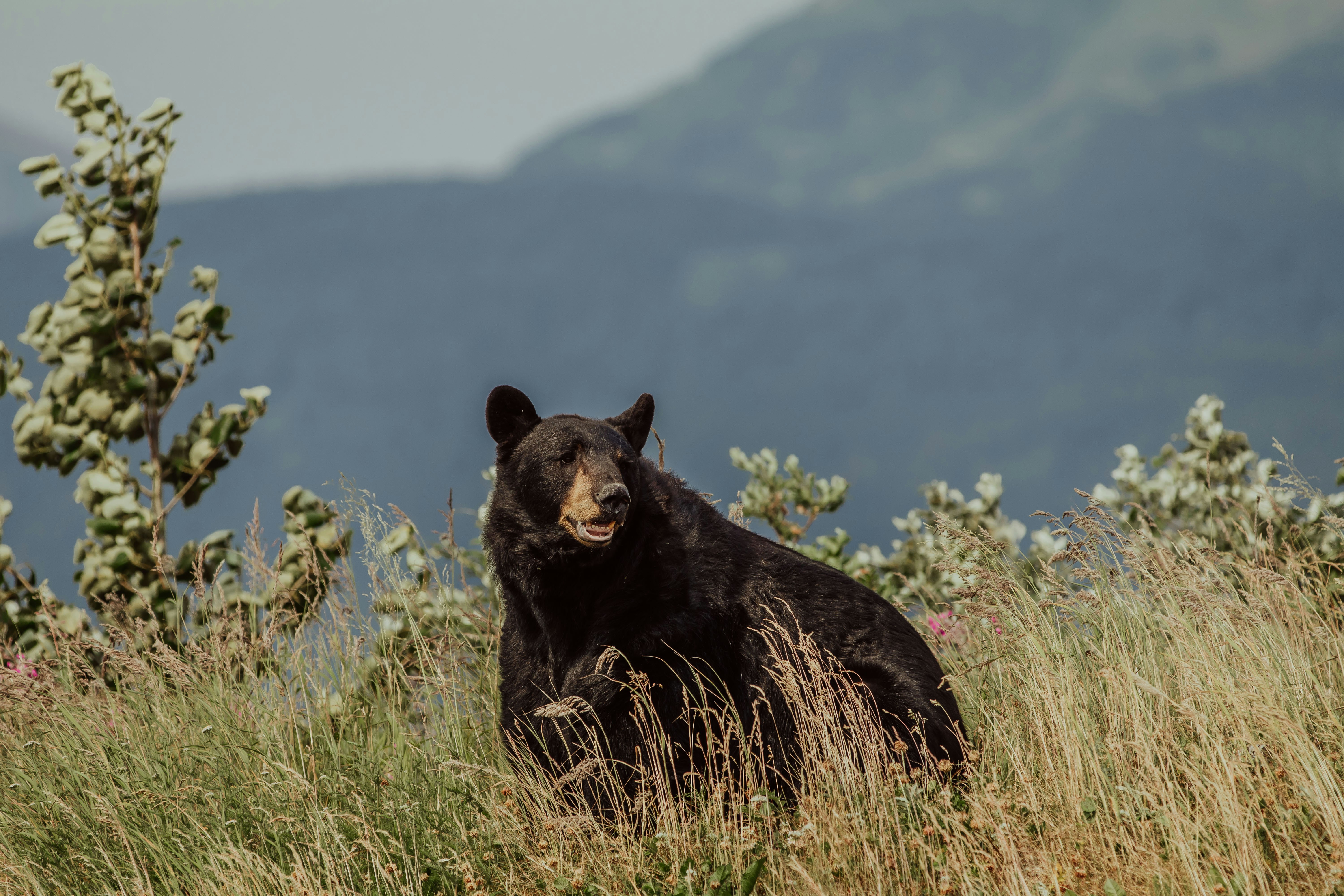
American black bears are adaptable omnivores whose survival, movement, and behavior are closely connected to seasonal food, habitat quality, and human activity.
Widespread across North America
The American black bear (Ursus americanus) is classified as Least Concern on the IUCN Red List because of its broad distribution and stable global population. It is the most widespread bear species in North America and remains common across much of its historic range.
In California, black bears are managed under the California Department of Fish and Wildlife’s 2025 Black Bear Conservation and Management Plan. CDFW estimates that approximately 60,000 black bears live in California, one of the largest statewide populations in the United States.
Biology and behavior
Black bears are the smallest of North America’s three bear species, but their size, movements, and use of space vary widely with region, season, habitat, and food availability.
Built for adaptability
Adult males commonly weigh 200–600 pounds, while females generally weigh 100–300 pounds. Adults are approximately 4–6 feet long and stand about 2–3 feet at the shoulder when on all fours.
Primarily solitary
Black bears generally live alone except when females are raising cubs. Individuals use home ranges rather than rigidly defended territories, and those ranges may overlap considerably.
Food shapes movement
Home-range size and seasonal movement respond to habitat productivity, social conditions, and the location of available food (Kemp 1976; Lindzey and Meslow 1977).
Raising the next generation
Black bears use delayed implantation, allowing breeding to occur during summer while cub development and birth are timed with the winter denning period.
Litter size is influenced by a female’s age, health, and food availability. Maternal investment is central to cub survival, and recruitment can be strongly affected by environmental conditions and human pressures (Hostetler et al. 2009).
Cubs also learn from their mother. By following her through seasonal habitats, young bears acquire knowledge of productive foraging areas, denning landscapes, and how to move through their environment. This generational social learning can shape later behavior.
Opportunistic omnivores
Seasonal foods
Black bears consume both plant and animal matter. Across most regions, much of their caloric intake comes from vegetation, including berries, acorns, grasses, and other seasonal foods (Guntly 2016). They generally seek the greatest caloric return for the least energy expenditure.
Predation
Although plant foods make up much of their diet, black bears are capable predators. Research has shown that bears can be important predators of deer fawns during the brief period when newborn fawns depend on camouflage and immobility for protection (Edge et al. 2023; Guntly 2016).
Scavenging and kleptoparasitism
In California, black bears frequently scavenge mountain lion kills. Research documented bears as the most common scavenger at lion kill sites and found kleptoparasitism in more than 70 percent of observed cases (Allen et al. 2021). Similar interactions between bears and other large carnivores occur across the world (Ordiz et al. 2020).
Habitat and seasonal requirements
Black bears occupy a broad range across North America, including Alaska, Canada, the Pacific Northwest, the northeastern United States, Florida, and northern Mexico. They are most often associated with forests but also use chaparral, riparian corridors, and mountainous terrain.
Habitat quality, human disturbance, and seasonal food influence survival and patterns of landscape use (Hostetler et al. 2009). Productive bear habitat must provide both reliable food and places where bears can travel, rest, and den securely.
Protective cover
Forests, chaparral, and riparian vegetation provide concealment, resting areas, travel routes, and escape cover.
Seasonal food
Berries, grasses, mast crops such as acorns, insects, carrion, and other foods become available at different times of year.
Secure winter dens
During winter dormancy, bears use protected sites such as caves, hollow logs, rock crevices, excavated spaces, and other shelters.
Preventing food-conditioned behavior
Black bears possess an exceptional sense of smell and readily use concentrated food sources. Conflict often begins when human food or attractants become easier to obtain than natural foods.
Attractants create risk
Unsecured garbage, livestock feed, orchards, compost, pet food, and other attractants can encourage repeated visits and food conditioning. Food-conditioned bears are more likely to behave boldly and require management intervention (Miller 2024).
Prevention comes first
Relocation has been attempted with habituated bears, but results vary and require adaptive management (Schaefer et al. 2021). Preventing access to attractants is often more effective than reacting after a pattern of conflict has developed.
Long-term coexistence depends on proactive attractant management, practical public outreach, consistent community participation, and management approaches that balance ecological function with human safety and tolerance.
References
View the complete reference list
Alagona, P. S., A. McInturff, and E. M. Pero. 2025. Recovering Grizzly Bears in California: A Feasibility Study. California Grizzly Alliance, California, USA.
Allen, M. L., L. M. Elbroch, and H. U. Wittmer. 2021. Can’t bear the competition: energetic losses from kleptoparasitism by a dominant scavenger may alter foraging behaviors of an apex predator. Basic and Applied Ecology 51:1–10.
California Department of Fish and Wildlife. 2025. Black Bear Conservation and Management Plan for California. California Department of Fish and Wildlife, Sacramento, California, USA.
Edge, A. C., J. P. Rosenberger, C. J. Yates, A. R. Little, C. H. Killmaster, K. L. Johannsen, D. A. Osborn, J. C. Kilgo, K. V. Miller, and G. J. D’Angelo. 2023. White-tailed deer (Odocoileus virginianus) fawn survival and the influence of landscape characteristics on fawn predation risk in the Southern Appalachian Mountains, USA. PLOS ONE 18:e0288449.
Guntly, K. M. 2016. Black bear (Ursus americanus) movements, diet, and impacts on ungulate neonate survival on the National Rifle Association Whittington Center, New Mexico. M.S. thesis, Texas Tech University, Lubbock, Texas, USA.
Hostetler, J. A., J. W. McCown, E. P. Garrison, A. M. Neils, M. A. Barrett, M. E. Sunquist, S. L. Simek, and M. K. Oli. 2009. Demographic consequences of anthropogenic influences: Florida black bears in north-central Florida. Biological Conservation 142:2456–2463.
Kemp, G. A. 1976. The dynamics and regulation of black bear Ursus americanus populations in northern Alberta. Bears: Their Biology and Management 3:191–204.
Lindzey, F. G., and E. C. Meslow. 1977. Home range and habitat use by black bears in southwestern Washington. Journal of Wildlife Management 41:413–425.
Miller, C. R. 2024. Human-bear conflict in North America (1880–2020): patterns, outcomes, and interactions.
Ordiz, A., M. Krofel, C. Milleret, I. Seryodkin, A. Tallian, O.-G. Støen, T. R. Sivertsen, J. Kindberg, P. Wabakken, H. Sand, and J. E. Swenson. 2020. Interspecific interactions between brown bears, ungulates, and other large carnivores. Pages 36–44 in V. Penteriani and M. Melletti, editors. Bears of the World. Cambridge University Press, Cambridge, United Kingdom.
Raithel, J. D., M. J. Reynolds-Hogland, D. N. Koons, P. C. Carr, and L. M. Aubry. 2017. Recreational harvest and incident-response management reduce human–carnivore conflicts in an anthropogenic landscape. Journal of Applied Ecology 54:1552–1562.
Schaefer, R. J., D. Moyles, S. McDonald, M. Cervelli, and D. Beck. 2021. Relocation of habituated black bears in the Klamath Mountains of California: an adaptive management case study. California Fish and Wildlife Journal 107:202–212.